




Clean water and environmental improvement
MEUS
Modernization of energy and utility sectors
MEUS - national project for comprehensive transformation of Kazakhstan’s energy and utilities systems.
Subscribe to the official MEUS Telegram channel.
Modernization of energy and utility sectors
MEUS - national project for comprehensive transformation of Kazakhstan’s energy and utilities systems.
News on the Modernization of Kazakhstan’s Energy and Utilities Sector
21.11.2025
21.11.2025
20.11.2025
20.11.2025
19.11.2025
19.11.2025
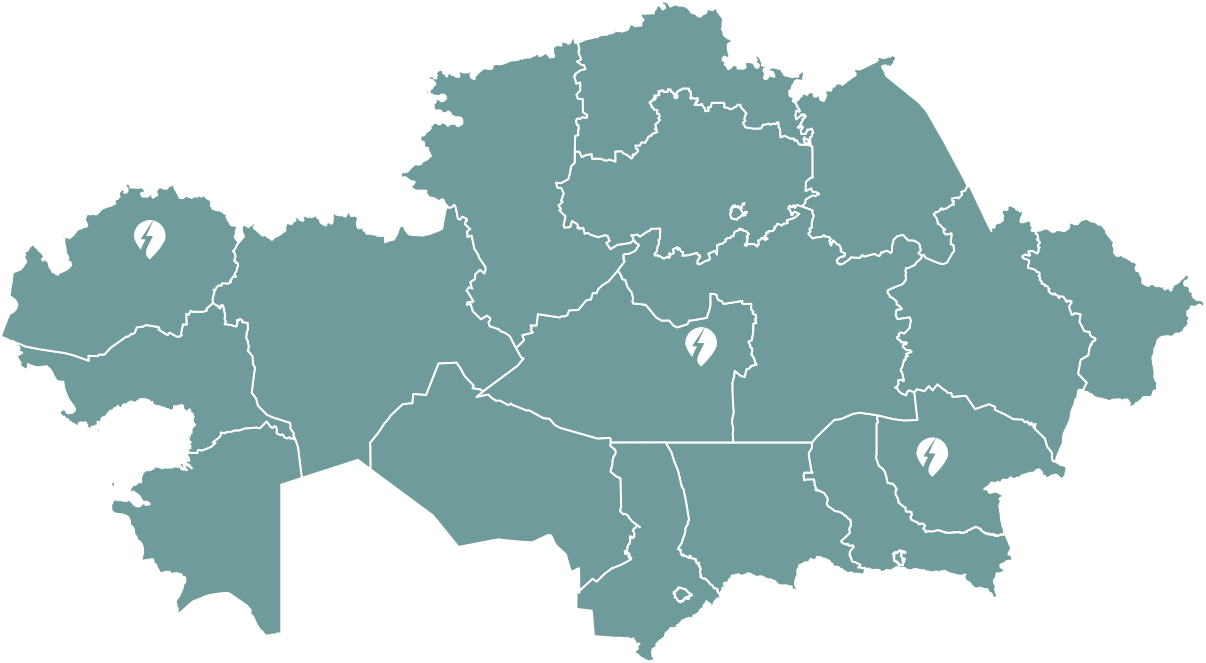
The interactive map displays plans, ongoing progress, and completed projects.
The National Project "Modernization of Energy and Communal Sectors" (MEKS) for 2025–2029 provides for a comprehensive renovation of networks and facilities for heat, electricity, and water supply, as well as wastewater disposal systems. The implementation of the National Project will reduce the accident rate and the level of infrastructure deterioration, provide the population with high-quality utility services, and contribute to the sustainable economic development of Kazakhstan.
Modernization and construction of energy and utility infrastructure.
Increasing the investment attractiveness of the energy and utility sectors
Increasing in-country value.
Development and implementation of mechanisms to compensate for public expenses when tariffs are increased.
Modernization and construction of infrastructure (networks and facilities) of the energy and utility sectors
Development and implementation of a comprehensive digitalization program
Creation of a sustainable and affordable financing mechanism
Ensuring the maximum use of products from domestic producers (DGP)
Mitigating the impact of the tariff burden on public expenses
Total investment volume
Answers to frequently asked questions
How will MEUS project affect the lives of Kazakhstani citizens?
MEUS has a comprehensive impact on citizens’ daily lives, delivering both economic and social benefits:
How will the installation of heat, water, and electricity meters help save on utility payments?
In the heat supply sector, a Smart Metering system will be implemented; in the electricity sector – Smart Grid; and in water supply and sewerage – Smart Water.
This will enable:
What are key directions of modernization in heat power supply?
Expected Outcomes:
The cost of delay in heating modernization plans:
What are key directions of modernization in water supply?
Comprehensive modernization of water supply networks and facilities will ensure:
The cost of delay in water supply modernization plans:
What are the key characteristics of regional development in Kazakhstan in terms of utility and energy infrastructure?
Infrastructure development is concentrated in major cities (Astana, Almaty, Shymkent) and industrial regions (Karaganda, Pavlodar, East Kazakhstan regions).
Remote, rural, and sparsely populated areas—particularly in the western and southern regions—face a shortage of quality utility infrastructure.
In several regions of the country, some water supply and wastewater facilities are fully owned by private companies. For example, in Shymkent and Pavlodar. Water utility enterprises in regional cities are being established with private-sector participation. In Shymkent, 78% of these enterprises are privately owned; in Karaganda, 49%; and in Pavlodar, 20%.
In cities with populations up to 20,000 and in rural district centers, water supply and wastewater systems are primarily operated by private water utility enterprises. There have been cases where privately owned water utility companies failed to meet their obligations. As a result, the facilities were returned to municipal ownership.
What are the key characteristics of the development of the country’s eastern regions in terms of utility and energy infrastructure?
The eastern regions of Kazakhstan border Russia and China, which supports the export of electricity.
Large distances between settlements and cold winters create a high demand for district heating and the modernization of networks.
The region is industrially developed, with a predominance of non-ferrous metallurgy, energy, and mechanical engineering sectors. It is one of the largest electricity consumers (including hydroelectric power plants on the Irtysh River).
Electricity supply: One of the best in the country due to local hydroelectric and thermal power plants, but there are localized outages in rural areas caused by worn-out transmission lines.
Water supply: The Irtysh River plays a central role, providing abundant water resources, although their distribution is uneven.
What are the key characteristics of the development of the country’s northern regions in terms of utility and energy infrastructure?
Features of Northern Regions of Kazakhstan (North Kazakhstan, Kostanay, Akmola, Pavlodar regions)
The northern regions are characterized by long winters with temperatures down to -30 °C and below, as well as population decline, particularly in small and rural settlements. In villages, this affects the prioritization of infrastructure development.
Electricity Supply: Well-developed networks due to proximity to coal-fired POWER PLANTs (e.g., Ekibastuz POWER PLANT). Centralized electricity supply is often used, even in remote settlements.
District Heating: Urban residents receive heat from centralized systems (Heating Electrical Stations). In rural areas, heating is mainly individual (stove or coal-based).
Water Supply: Cities are served by centralized systems, but water quality does not always meet sanitary standards. In villages, water comes from standpipes, wells, and in some locations, delivered water.
Wastewater (Sewerage): Centralized sewer systems operate only in major cities.
What are the key characteristics of the development of the country’s southern regions in terms of utility and energy infrastructure?
Southern Regions of Kazakhstan (Almaty Region, Zhetysu, Turkestan, Shymkent) are characterized by mild winters. Consequently, the climate places lower demand on district heating, but there is a shortage of drinking water, particularly in Turkestan Region and Zhetysu.
High seismic activity limits centralized infrastructure development.
Agriculture is the predominant sector in the region, resulting in higher water consumption compared to other regions of Kazakhstan.
The region is known for high birth rates, population density, and a high level of urbanization in Shymkent and Almaty Region, alongside a large number of rural settlements.
Electricity supply coverage is high. However, the region is energy-dependent on the central and northern parts of the country, leading to occasional outages during peak hours.
What are the key characteristics of the development of urban and rural settlements in terms of utility and energy infrastructure?
Electricity Supply
Coverage: High — nearly 100% of the population.
Issues: Worn-out networks, especially in rural areas; power outages in remote villages; energy isolation in the southern and western regions of the country.
Heat supply
Cities (Astana, Almaty, etc.): Mainly centralized heating through Heating Electrical Stations.
Rural areas: Mostly individual heating (coal, firewood, gas).
Issues: Aging infrastructure, inefficient heating systems, high heat losses.
Water Supply
Major cities: Centralized, relatively stable water supply.
Rural regions: Wells, boreholes, delivered water.
Issues: Irregular water supply, source contamination, shortage of drinking water in southern and western regions.
Wastewater (Sewerage)
Cities: Centralized sewer systems (often outdated).
Villages: Cesspools, septic tanks.
Coverage: Less than 50% of the population nationwide, particularly low in rural areas.
Service Coverage:
What are the key characteristics of the of the country’s western regions in terms of utility and energy infrastructure?
Western Regions of Kazakhstan (Atyrau, Mangistau, West Kazakhstan, Aktobe regions)
The climate is arid, semi-desert, and desert. The region is rich in oil and gas, but infrastructure development is uneven. The main issue is a shortage of freshwater, despite high resource revenues.
District Heating: Mostly autonomous; few centralized Heating Electrical Stations.
Electricity Supply: High coverage, but rapid industrial development causes frequent outages in remote areas.
Water Supply: One of the most pressing issues is the acute shortage of freshwater, primarily sourced from the Ural River. Delivered water is also used.
What does comprehensive modernization in the energy sector entail?
Replacement of worn-out components with more modern ones;
The cost of delay in electricity supply modernization plans:
What is the state of wear and tear in electric power infrastructure?
The average wear of electricity supply networks is 76%, while the wear of main equipment at power plants has reached 56.8%. Over one-third of power plants have equipment wear in the range of 70–90%.
The highest level of wear is observed at thermal power plants and large-scale power plants. At 14 power plants, wear exceeds 80%, and at 21 plants, wear ranges from 60–80%. Most accidents occur at plants with wear above 80%.
The situation in regional electric grid companies remains challenging. Six electric grid companies have a critical level of wear (85–97%), and another six companies have a high level of wear (65–85%), increasing the risk of accidents and disruptions in power supply.
The efficiency of power grids is further reduced by asynchronous electric motors and transformers, which consume reactive power.
What is the state of wear and tear in heat power infrastructure?
As of early 2023, the total length of district heating networks in cities is 12.1 thousand km, of which 6.7 thousand km require replacement, with an average wear level of 55%. The required investment volume is approximately 2.2 trillion tenge.
According to the Local Administrations data, 83 natural monopoly entities (NMEs) provide heating services in 74 cities. Of these: 61 municipal enterprises manage 10.2 thousand km of networks (wear – 52%); 22 private entities manage 1.9 thousand km of networks (wear – 70%).
Breakdown by degree of network wear:
Wear less than 50%: 45 cities, total length 4.3 thousand km, 1.4 thousand km require replacement; serviced by 52 NMEs (39 state, 13 private).
Wear 50–70%: 19 cities, total length 5.9 thousand km, 3.7 thousand km require replacement; managed by 20 NMEs (15 state, 5 private).
Wear over 70%: 7 cities, total length 1.9 thousand km, 1.6 thousand km require replacement; managed by 7 entities (4 state, 3 private).
In four entities (Vodokanal State-Owned Utility Enterprise Based on the Right of Economic Management of Ridder Local Administration, Shemonaikha Su Arnasy LLP, Arkalyk Fuel & Energy Complex State-Owned Utility Enterprise, Ryabinina Ye.F. Individual Entrepreneur) in Ridder, Shemonaikha, and Arkalyk, networks totaling 52 km have exceeded their normative service life (over 25 years).
What is the state of wear and tear in wastewater infrastructure?
Wastewater infrastructure extent of wear across Kazakhstan exceeds 60%, and in some cities it surpasses 90%. In major cities, many sewage systems were constructed in the 1950s–1970s. Consequently, their operational efficiency is extremely low, and the technologies and equipment in use are long outdated.
Comprehensive renovation and modernization of sewage treatment facilities (STFs) include the following:
The cost of delay in wastewater management plans:
What is the state of wear and tear in water supply infrastructure?
The average wear and tear level in water supply infrastructure is 40%. Many water supply networks are over 30 years old. In some regions, the wear and tear of water supply networks and facilities exceeds 50%.
Access to water supply services is 98.9% in cities and 96.6% in rural areas.
Out of 89 urban settlements, the population of 65 cities is fully supplied with centralized water. Out of 6,256 villages, 5,130 have access to water supply services. Urban populations in 9 regions enjoy 100% access to water supply services.
Due to the high wear and tear of Nura group water pipeline in Akmola Region, a local state of emergency was declared in 2023.
Effects of worn-out water supply networks:
What Kazakhstani regions will be covered by modernization of the energy and utilities sectors? In which areas are this issue most relevant?
The National Project covers all the Kazakhstani regions. It encompasses the following sectors:
In the power supply networks, the average level of depreciation is 76%. At power plants, the wear of main equipment has reached 56.8%, with more than one-third of the stations operating with depreciation levels ranging from 70% to 90%.
The heat supply sector, from heat generation to consumption, is characterized by a low efficiency rate (an average of 75% for boilers and 52% for the overall system), high emissions, and significant heat losses (18–42% during the transportation and distribution stages).
In the water supply sector, the average level of infrastructure depreciation is 40%. Many water pipelines are over 30 years old. In some regions, the wear and tear of water supply networks and facilities exceed 50%.
The level of deterioration of wastewater treatment facilities across Kazakhstan exceeds 60%, and in some cities, it is over 90%. In major cities, sewerage systems were built back in the 1950s–1970s, resulting in extremely low operational efficiency. The technologies and equipment in use are long outdated.
Thus, modernization will be carried out across all four sectors.
What sources of financing are being considered for the implementation of Modernization of the Energy and Utilities Sectors Project?
Modernization projects in the energy and utilities sectors are generally characterized by low profitability for private capital and foreign investors. Therefore, it is essential to develop mechanisms for attracting investment, including the following:
Main sources of financing:
The application of diverse financing mechanisms contributes to the effective renewal and modernization of the country’s energy and utilities networks.”
What systemic issues are observed in the Electric Power Sector?
The emerging deficit in Kazakhstan is being covered through imports from Russia at high prices. This is due to increased electricity consumption, worn-out infrastructure, and a high incidence of failures in the energy system. As a result, electricity supply to consumers is restricted, causing dissatisfaction among the population and businesses.
According to the Ministry of Energy, in 2025 Kazakhstan is projected to face an electricity deficit of 5.7 billion kWh, which is 72.7% higher than the previous forecast. Electricity consumption is expected to reach 122.8 billion kWh, while production is projected at 117.1 billion kWh.
What types of support will be provided to socially vulnerable groups in the event of rate hike?
Types of Social Support for Socially Vulnerable Groups in the Republic of Kazakhstan Include:
Since 2024, 6,196 low-income families have been receiving assistance totaling over 140 million tenge.
In December 2023, the Ministry of Industry and Construction established a new expenditure threshold for consumers. Housing assistance is provided if utility costs exceed 10% of the average monthly total family income.
Previously, this threshold ranged from 2% to 20%.
Documents are uploaded automatically from government databases, except for utility bills.
Which International Agreements, Arrangements, and Commitments adopted by Kazakhstan contribute to modernization of the energy and utilities sectors?
Will the implementation of the energy and utility network modernization project lead to higher rates, and if so, by how much could they increase?
The situation in each region is individual. If a rate increase is necessary, the relevant government authorities review detailed calculations submitted by service providers.
Overall, rate policy should be fair, balanced, and incentivizing, ensuring both sustainable sector financing and protection of the interests of the population and businesses.
Main Objectives of Rate Policy:
Rate policy should avoid the following:
If you have any questions, comments, or suggestions, please contact us.